
Now Offering Palliative Care
Comfort, Dignity, and Expert Care—Right Where You Belong.
We are proud to announce the launch of our Palliative Care Program! Made to work alongside your current doctors, our nurse-led team focuses on reducing pain and stress from the moment of diagnosis. You don’t have to wait for hospice to get the comfort you deserve.

Parrish Health Systems of Ohio | We Care About You.
Nurse Owned & Operated.
Choose our hospice care for compassionate support that honors life with dignity and comfort. We’re here to guide you with expertise, empathy, and personalized care every step of the way.
Years of Experience
- Alzheimer's & Dementia Trained Staff

Welcome to


Parrish Health Systems of Ohio provides high standards of hospice care focusing on comfort rather than just a cure. Our practice encourages our patients comfort in their own community with better quality end-of-life care inside their own home.
Our mission is simple: to enhance lives, empower families, and elevate healthcare standards—one person, one family, one business at a time. Thank you for trusting us to be part of your journey.
Welcome to the Parrish family—where care meets excellence.

We Welcome You.
At Parrish Health Systems of Ohio, we believe in providing compassionate care and expert guidance when it matters most. Whether you’re seeking supportive hospice care, personalized in-home assistance through Parrish at Home, or strategic solutions with Parrish Business Consulting, we’re here to serve you with integrity, expertise, and heartfelt dedication.

Welcome to our family
There is a profound, irreplaceable comfort in the familiar. It is the sunlight filtering through a favorite window, the soft hum of your own living room, and the quiet reassurance of having the people you love closest to you. We believe that life’s final chapters shouldn’t be defined by clinical walls, institutional schedules, or the exhaustion of navigating facilities. Instead, they should be defined by dignity, warmth, and peace.
Bringing care directly into the home is more than just a medical service—it is a commitment to honoring the human spirit. When expert care comes to your doorstep, a beautiful shift happens. The heavy burden of medical management is lifted from the shoulders of the family. A spouse can simply return to being a spouse; a child can simply be a child again.


Let's talk about hospice.
What is
Hospice?
Hospice involves comprehensive care to ensure the comfort and support of patients and their families when there is a life limiting illness. Hospice care is delivered by a team of specialists with experience and expertise in end-of-life care.
Why
Hospice?
The hospice philosophy is that there is a lot of living to accomplish during all phases of life. With expert symptom management through hospice, patients can find dignity, meaning, and peace during their last months, weeks or even days of life.
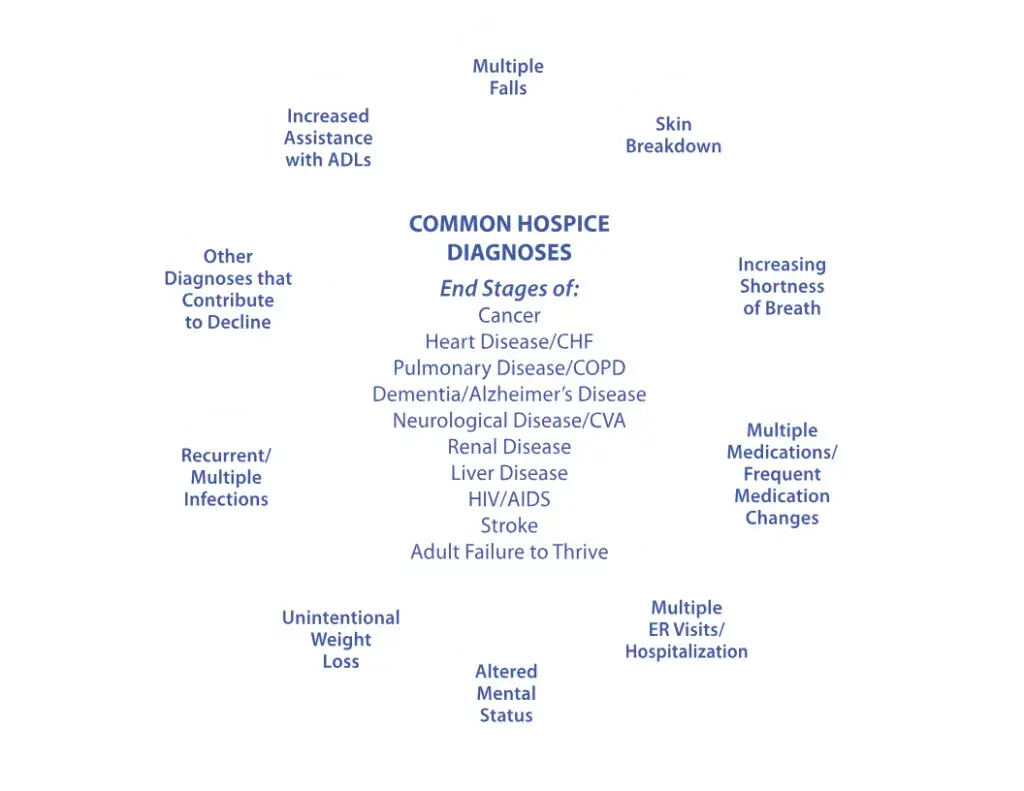
Possible Indicators of Hospice Eligibility
If two or more are present, hospice should be considered.
Hospice professionals continue to be concerned about the number of people accessing hospice care late in the course of an illness. The NHPCO report indicates that 53.8 percent of Medicare beneficiaries received hospice care for 30 days or less in 2018. A quarter (27.9 percent) of beneficiaries received care for seven days or less, which is considered too short a period for patients to fully benefit from
the person-centered care available from hospice.
Understanding Code Status
Making Informed Decisions About Your Care
What is Code Status?
Code status refers to what medical actions healthcare providers should take if someone's heart stops beating or they stop breathing. This decision is deeply personal and reflects individual preferences for medical intervention in life-threatening situations.
Common Questions
Yes. Code status decisions can be revisited and changed at any time as circumstances, health status, or preferences evolve.
No. A DNR order is not about giving up—it's about defining what quality of life means to you and ensuring medical care reflects your values.
The individual receiving care makes this decision whenever possible. If they cannot make the decision themselves, their designated healthcare proxy or legal representative makes it on their behalf.
While legal documentation is important, you don't necessarily need a lawyer. Your physician can help you complete the appropriate medical orders. We recommend consulting with your healthcare provider and considering an advance directive.
Full Code
Full Code means that if a person’s heart stops or they stop breathing, the medical team will do everything possible to restart the heart and lungs. This includes:
- Chest compressions
- Rescue breathing
- Defibrillation
- Intubation
- Cardiac medications
- Surgical intervention
What are the main complications of CPR?
- Aspiration & Vomiting: During CPR, the forceful chest compressions triggers vomiting in the person being resuscitated (revive from unconsciousness or apparent death).
- Broken Ribs: The application of force during CPR chest compressions leads to the cracking or fracturing of ribs, particularly in older individuals or those with fragile bones.
- Internal Brain Injuries: CPR aims to maintain the oxygen supply to the brain, but it inadvertently cause injuries to the brain if not performed correctly.
- Abdominal Distension: In some cases, the forceful chest compressions during CPR leads to abdominal distension, causing the abdomen to swell due to the accumulation of air or other substances in the digestive tract.
Aspiration Pneumonia: Aspiration pneumonia is a severe complication that results from inhaling vomit during CPR.
DNR
DNR stands for “Do Not Resuscitate.” A DNR order tells healthcare providers not to perform CPR (cardiopulmonary resuscitation) if the person’s heart stops or they stop breathing. A DNR order does NOT mean “do not treat.”
With a DNR order, the person will be allowed to die naturally without aggressive resuscitation interventions:
- Comfort care and pain management
- Treatment for infections, injuries, or other medical conditions
- Assistance with daily activities
- All other appropriate medical care
DNR only applies to resuscitation efforts when the heart or breathing stops.
DNR complications:
- Potential for survival in reversible conditions
- Family guilt or conflict after death
- Uncertainty about the decision
Let's talk about hospice.
Services
All of our staff are trained in specialized care for Alzheimer’s and Dementia.
Services Provided
- Nurse on Call 24/7
- Skilled Nursing Services
- Medical Social Services
- Physician Services
- Hospice Aide Services
- Managing pain and symptoms of life-limiting illnesses
- Inpatient Care
- Inpatient Respite Care
- Counseling for physical, emotional and spiritual support
- Bereavement Support to Family
- Volunteer Services
- WISH Program
- Memory Book Program
Accepted Insurance
Hospice Care
• Traditional Medicare (Part A)
All Medicare Advantage plans, including those marketed in Lucas, Wood, Ottawa and Fulton Counties:
- Aetna Medicare
- Anthem Blue Cross and Blue Shield
- CareSource Medicare / MyCare Ohio
- Devoted Health
- Humana
- Lasso Healthcare
- MediGold (Mount Carmel)
- Medical Mutual – MedMutual Advantage
- Paramount Elite
- Perennial Advantage
Accepted Insurance
- PrimeTime Health Plan
- SummaCare
- The Health Plan
- UnitedHealthcare / AARP Medicare Advantage
- Valor Health Plan
- Wellcare / Wellcare by Allwell (Buckeye)
- Zing Health
- Dual-eligible (D-SNP) and MyCare Ohio plans from any carrier
- Ohio Medicaid
- Ohio Medicaid managed care – Buckeye, CareSource, Molina
Have a Medicare Advantage plan? When you elect hospice, your hospice care is covered by Original Medicare Part A no matter which Advantage plan you carry. You stay enrolled in your plan for everything else.
Call us and we will walk you through it.
Palliative Care
- Traditional Medicare (Part B)
- Medicare Advantage – Buckeye, CareSource, Medical Mutual
- Ohio Medicaid and Ohio Medicaid managed care – Buckeye, CareSource, Molina
Not sure about your plan? Call us at (419) 537-7600 and we will verify your coverage for you.

Levels of Hospice Care as Defined by Medicare
When a doctor determines that a patient most likely has no more than six months to live (if the illness runs its normal course), the person or their family may choose to stop trying to cure the illness and opt to receive hospice care instead.
Hospice, also called “comfort care,” focuses on managing pain and keeping a person comfortable so that they can enjoy a good quality of life for the remainder of their time left.
Medicare defines four distinct levels of hospice care. This benefit provides goods and services to allow you and your family to stay together in the comfort of your home, unless you need care in an inpatient facility, for the duration of your terminal illness.
Under the Medicare hospice benefit, the patient is still responsible for the deductible and
coinsurance amounts for expenses incurred due to health problems not related to the terminal
illness.
One person may experience all four levels, perhaps in just a week or 10 days of hospice services. Another person may experience one level of care throughout the duration of his or her hospice care. Each level of care meets specific needs, and every hospice patient is unique.
Every Medicare-certified hospice provider must provide these four levels of care.
Level 1: Routine Home Care
Routine home care is the most common level of hospice care. It is provided wherever the patient calls home – a private residence, a family member’s home, an assisted living community, or a nursing facility.
At this level, the patient’s symptoms are stable enough to be managed with scheduled visits from the hospice team. Care is delivered by an interdisciplinary team and is tailored to the needs of the patient and family.
Routine home care includes:
- Scheduled visits from a hospice registered nurse, with a nurse available by phone 24 hours a day
- Hospice aide visits for personal care and bathing
- Medical social work services
- Spiritual and bereavement counseling
- Physician oversight by the hospice medical director, working with the patient’s own doctor
- Medications, medical equipment and supplies related to the terminal ilness
- Therapy services when they are provided for comfort and quality of life
- Trained volunteer support
Under the Medicare hospice benefit, there is no deductible and no coinsurance for covered hospice services related to the terminal illness.
A small copayment may apply for certain outpatient prescription drugs and for inpatient respite care. Care and treatment for conditions unrelated to the terminal illness continue to be billed to the patient’s regular Medicare or insurance coverage, where the usual deductible and coinsurance apply.
Hospice does not require a patient to be homebound, and it does not require that the patient be expected to improve.
Level 2: Continuous Home Care
Continuous home care is provided during a crisis when a patient needs predominantly nursing care to manage acute symptoms and remain at home. It is available for a minimum of eight hours within a twenty-four-hour period, and those hours do not have to be consecutive.
More than half of the total hours of care must be provided by a registered nurse, licensed practical nurse or licensed vocational nurse. A hospice aide or homemaker may provide the remainder.
Continuous home care is a short-term level of care. The patient’s condition is reassessed continually, and once the crisis is resolved the patient returns to routine home care.
Symptoms that may call for continuous home care include:
- Unrelieved pain
- Severe nausea and vomiting
- Severe shortness of breath
- Severe anxiety or panic
- Acute or complicated wound care needs
- A breakdown in the primary caregiver support system
The purpose of continuous home care is to keep the patient at home through the crisis rather than transfer to a hospital.
Level 3: General Inpatient Care
General inpatient care is for short-term pain control or symptom management that cannot be provided in any other setting. It is not elective, and it is not based on where the patient or family would prefer to be.
It is provided when the symptoms are severe enough that they cannot reasonably be managed at home, even with continuous home care.
General inpatient care may be provided in:
- A Medicare-certified hospital
- A Medicare-certified skilled nursing facility with the required nursing staffing
- A hospice inpatient facility
Nurses are available around the clock to administer medications and treatments and to provide emotional support. General inpatient care is short-term by design.
As soon as symptoms are under control, the patient returns to routine home care in their own home. Hospice care continues without interruption throughout.
Level 4: Respite Care
Respite care exists for the family. When the caregiver needs rest, or when circumstances at home make caregiving temporarily impossible, the patient may be admitted to a contracted inpatient setting for a short stay.
Respite care is available for up to five consecutive days at a time. At the end of the respite stay, the patient returns home and routine home care resumes. Hospice care is not interrupted, and the patient is not discharged from hospice.
You may use respite more than once. A small copayment may apply for inpatient respite care.
Caregiving is demanding work, and needing a break is not a failure. If you are reaching the end of what you can carry, tell your hospice nurse. That is what respite is for.
Determining Level of Care
In order to qualify for hospice care, hospice medical director or physician member of the interdisciplinary group, together with the patient's attending physician if the patient has one, certifies the terminal illness, with a life expectancy of six months or less; the decision to treat someone at a higher level of care falls to the hospice physician. With four levels in place, no terminally ill patient should ever be left without the appropriate care.
"Nurse-owned. Nurse-led. Rooted in trust."
Why Families Choose Choose Us
Why Families Choose Us
Nurse-owned. Nurse-led. Rooted in trust.
Nurses who have done this work
Our agency was built by a nurse, and nurses lead it still. Every plan of care is shaped by people who have sat at a bedside at three in the morning.
Dementia care is our specialty
All of our staff are trained in caring for people with Alzheimer’s disease and other dementias – the agitation, the swallowing changes, the long goodbye that families describe. This is what we know best.
A nurse answers, day or night
Twenty-four hours a day, every day of the year, a hospice nurse answers our phone. Not an answering service. A nurse.
We work with your own doctor
Patients keep the physician they trust. Our hospice physician and medical director work alongside them, not in place of them.
Care wherever home is
A house, an apartment, a daughter’s spare room, an assisted living community, a nursing facility. We come to you.
The family is the patient too
Social work, chaplain support, volunteers, and bereavement care for your family for thirteen months after a death. That is part of the benefit, and it is part of what we do.

Testimonials & Client Success
Thank you for sending support for our staff this week. We have had our third hospice death this morning. Other hospice programs are not supportive like you. I just want you to know how much we love your team. You need to be very proud. Please share with them we appreciate all of you.
Toledo Area Nursing Home

"Nurse Owned and Operated"
“Nurse Owned and Operated: Compassionate Care, Rooted in Expertise”
At Parrish Health Systems, we believe healthcare should be as compassionate as it is skilled—because no one understands patient care like those who’ve dedicated their lives to it. As a nurse-owned and operated agency, every service we provide is infused with firsthand clinical knowledge, unwavering advocacy, and a deeply personal commitment to your well-being.
Here, you’re not just a patient—you’re a person. Our team of nurse leaders ensures that your care is tailored, empathetic, and grounded in the latest evidence-based practices. Whether you’re seeking support for yourself or a loved one, you’ll experience the difference that comes from a system built by nurses, for nurses, and for the communities they serve.
Welcome to healthcare, redefined by those who know it best.